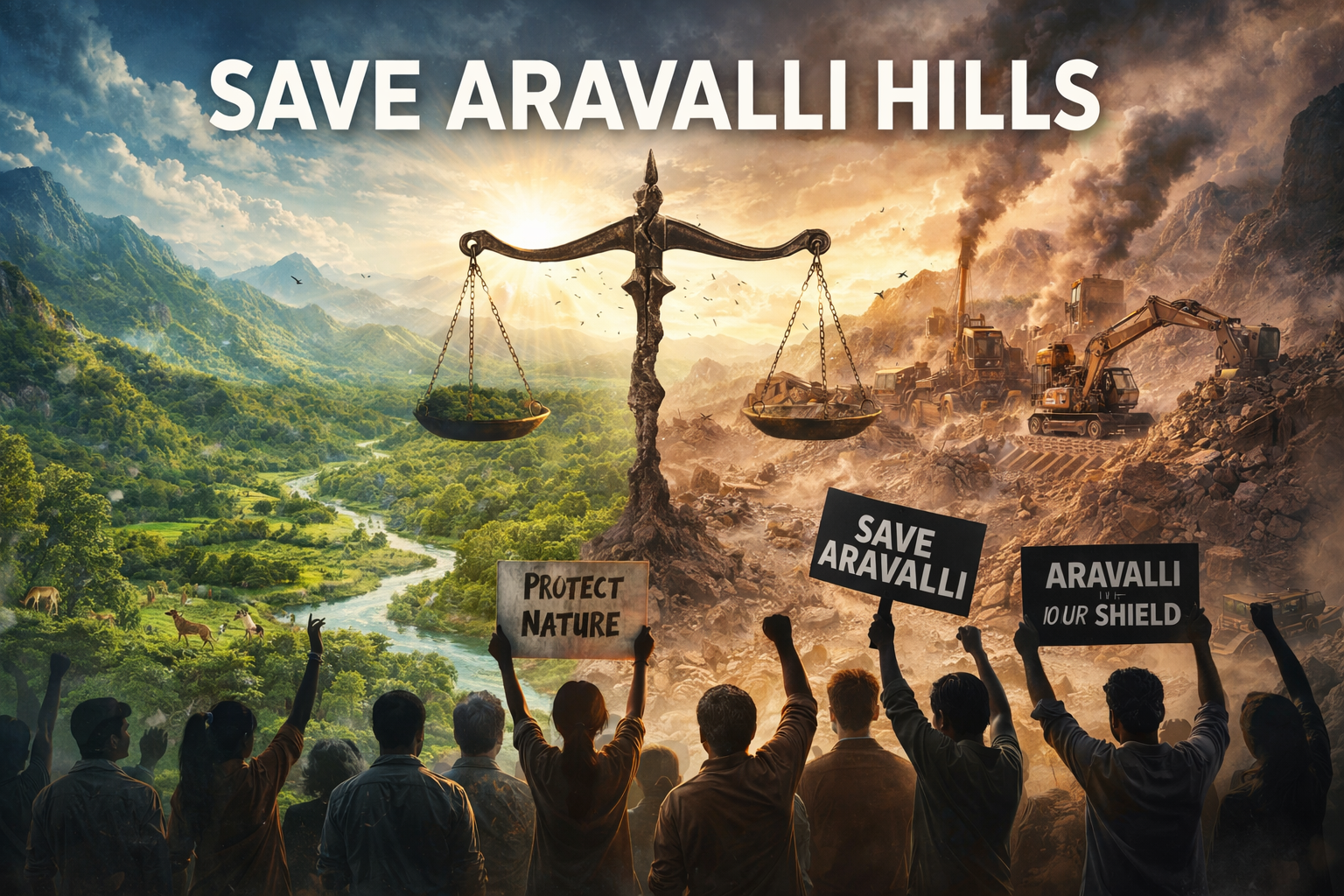
Aravalli Hills Under Threat: Why the Government and Supreme Court Are Wrong—and Why We Must Fight to Save India’s Oldest Mountain Range
The Aravalli Hills are not just a geographical feature of India; they are a natural shield, climate regulator, and lifeline for millions of people across North India. Stretching over 690 kilometers from Gujarat to Delhi, the Aravalli range is one of the oldest mountain systems in the world, older even than the Himalayas.
Yet today, this ancient ecosystem is facing an unprecedented threat. Policies, mining permissions, real estate projects, and recent interpretations by the government and even the Supreme Court have opened the door to what many environmentalists call the systematic destruction of the Aravalli Hills.
This article explains what is happening, why the Supreme Court’s position is deeply flawed, and why citizens must rise—peacefully, legally, and collectively—to protect the Aravallis before it is too late.
What Are the Aravalli Hills and Why Do They Matter?
The Aravalli range plays a critical ecological role in India:
- Acts as a natural barrier preventing the spread of the Thar Desert
- Regulates groundwater recharge
- Supports biodiversity, including leopards, hyenas, jackals, and rare bird species
- Protects Delhi-NCR from extreme heat, dust storms, and pollution
- Maintains rainfall patterns in Rajasthan, Haryana, and Gujarat
Environmental studies have repeatedly shown that areas where Aravalli forests are intact experience lower temperatures, better air quality, and stable water tables.
Destroying the Aravallis is not “development.”
It is environmental suicide.
What Is the Government’s Plan?
Over the past decade, multiple state governments—especially Haryana and Rajasthan—have:
- Allowed mining in Aravalli regions under different classifications
- Reclassified forest land as “non-forest” or “gair mumkin pahad”
- Approved real estate, roads, and commercial projects
- Reduced the scope of environmental clearances
The justification is always the same:
👉 Economic growth, infrastructure, and urban expansion
But the cost is paid by nature, climate, and future generations.
The Supreme Court’s Role: Why Many Believe It Is Wrong
The Supreme Court of India has historically been seen as a guardian of environmental justice. However, in recent rulings related to the Aravalli Hills, the Court has taken positions that many environmentalists strongly disagree with.
Key Concerns with the Supreme Court’s Stance
- Narrow Interpretation of “Forest”
The Court relied on technical land records instead of ecological reality.
If a hill is not officially recorded as “forest,” it may not receive protection—even if it functions as one. - Ignoring Scientific Evidence
Numerous expert reports warn that Aravalli degradation will:
- Increase desertification
- Worsen Delhi’s pollution
- Trigger water scarcity These warnings were not given adequate weight.
- Over-Reliance on State Governments
States that benefit financially from mining and construction were trusted to regulate themselves—an obvious conflict of interest. - Development Over Survival
The Court’s approach suggests that environmental protection is negotiable if economic arguments are strong enough. This is a dangerous precedent.
👉 From an environmental and moral standpoint, this approach is wrong.
Why This Is Not Just a Legal Issue, But a Survival Issue
The destruction of the Aravalli Hills directly affects:
- Delhi-NCR air pollution
- Extreme heatwaves
- Water shortages
- Floods and soil erosion
- Loss of wildlife corridors
In simple terms:
No Aravallis = hotter cities, dirtier air, less water, and an unlivable future.
This is not alarmism.
This is science.
Who Benefits From Destroying the Aravallis?
Let us be honest.
The biggest beneficiaries are:
- Mining companies
- Real estate developers
- Short-term revenue-driven governments
The biggest losers are:
- Farmers
- Urban citizens
- Wildlife
- Future generations
Environmental damage is permanent.
Economic gains are temporary.
Why We Must Fight to Save the Aravalli Hills
When institutions fail to protect nature, citizens must step up.
This does NOT mean violence or chaos.
It means democratic, legal, and public action.
Ways to Fight for Aravalli Conservation
- Public Awareness
Blogs, social media, videos, and local campaigns matter. - Environmental Litigation
Citizens and NGOs can file fresh PILs backed by scientific data. - Political Pressure
Vote, question representatives, and demand accountability. - Media Engagement
Silence helps destruction. Coverage creates pressure. - Community Action
Local resistance has historically saved forests and rivers in India.
Development vs Environment: A False Choice
The idea that we must choose between development and environment is a false narrative.
True development:
- Is sustainable
- Protects natural systems
- Thinks long-term
Destroying the Aravallis for short-term profit is not development—it is exploitation.
Lessons From the Past: When Nature Is Ignored
India has seen the consequences before:
- Yamuna floodplains destroyed → floods
- Wetlands encroached → water crises
- Forests cut → climate disasters
The Aravalli Hills are next.
Once gone, they cannot be rebuilt.
A Message to the Supreme Court and the Government
Respectfully but firmly, it must be said:
- Legal technicalities cannot override ecological truth
- Economic arguments cannot justify irreversible damage
- Courts exist to protect constitutional values—including the right to a healthy environment
The Supreme Court can still correct course.
The government can still change policy.
But only if people demand it.
The Fight for Aravalli Is the Fight for India’s Future
Saving the Aravalli Hills is not about ideology or politics.
It is about air, water, climate, and life.
If the government and even the Supreme Court fail to protect them, the responsibility falls on the people—peacefully, legally, and relentlessly.
Because once the Aravallis are destroyed,
no court order, no policy, and no apology will bring them back.
The time to act is now.