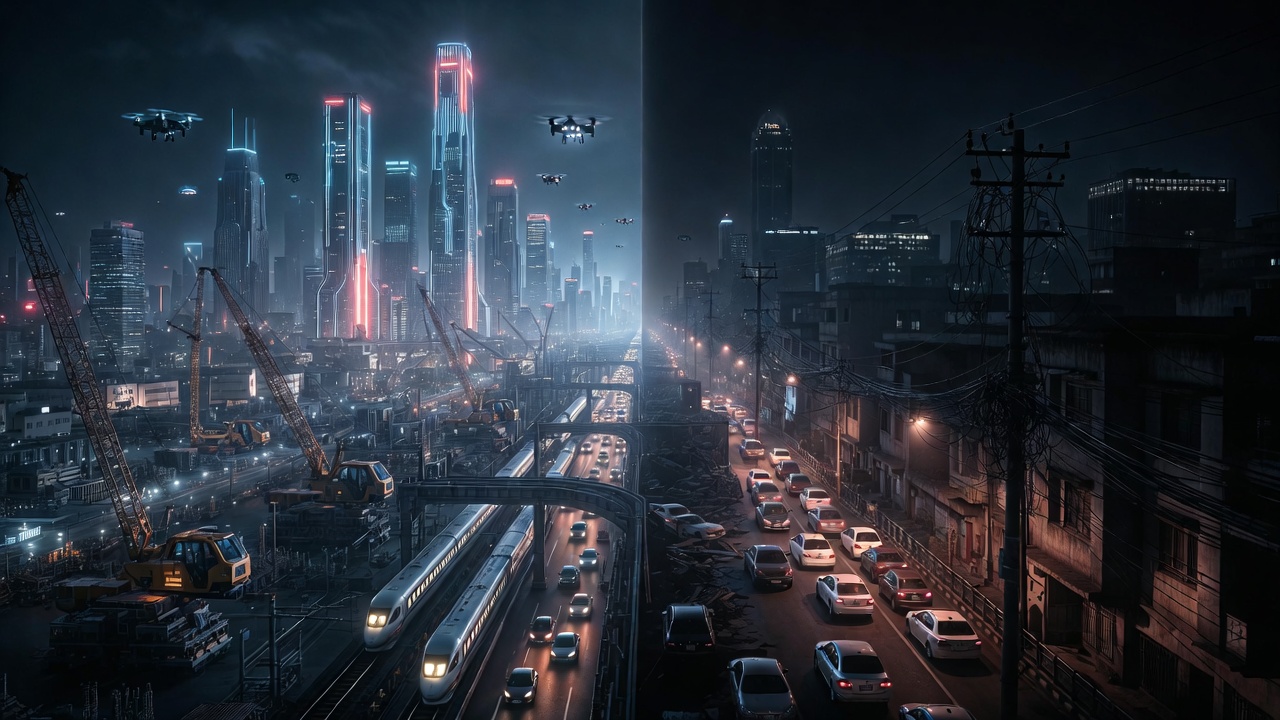
Hello Friends, In recent years, many Indians have started asking a difficult but important question – Why is China moving so fast in technology and infrastructure, while India still struggles with basic execution? From futuristic 8D world cities, AI-driven construction, and record-breaking road projects to advanced manufacturing and smart cities, China seems to be racing ahead. On the other hand, India—despite having talent, population, and democracy—appears slow and stuck.
This article explores why India is unable to match China’s pace, what China is doing differently, and what India must change to compete in the future.
China’s Rapid Growth: What the World Is Seeing

China’s development story is not just about money—it’s about speed, planning, and execution.
1. Ultra-Fast Infrastructure Development
China has shocked the world by:
- Building thousands of kilometres of highways in record time
- Using AI and automation to construct roads, bridges, and railways
- Completing entire cities and industrial zones in just a few years
In some projects, China has reportedly used AI-powered machines and 24/7 construction cycles to complete road stretches in a single day—something unimaginable in India.
2. Smart Cities and Future Technology
China is aggressively investing in:
- Smart cities powered by AI and IoT
- Fully digital traffic systems
- AI surveillance and urban planning
- Advanced public transport and bullet trains
The concept of 8D or immersive digital cities shows how China blends technology with urban planning, creating cities that are efficient, connected, and futuristic.
Then Why Is India Lagging Behind?
India has talent, engineers, and global recognition. Yet execution remains weak. The reasons are systemic, not just political.
1. Slow Bureaucracy and Red Tape
One of India’s biggest enemies is bureaucratic delay.
In India:
- Files move slowly
- Permissions take months or years
- Multiple departments overlap
- Projects get stuck in approvals
In China:
- Decisions are fast
- A clear authority structure exists
- Projects are executed without delay
While democracy is India’s strength, over-complex administration has become a weakness.
2. Political Blame Game Over Long-Term Vision
In India, politics often focuses on:
- Elections
- Short-term popularity
- Blaming previous governments
In China:
- Governments follow 30–50-year development plans
- Leadership continuity ensures long-term execution
Indian governments change, priorities change, and projects suffer. Infrastructure needs consistency, not constant policy shifts.
3. Corruption and Leakages
Corruption remains a serious issue.
- Funds allocated for roads and tech often don’t fully reach execution
- Contractors compromise quality
- Delays increase costs
China, despite criticism, maintains strict discipline and punishment for corruption—especially in large infrastructure projects.
4. Risk-Averse Mindset
India often hesitates to take bold risks.
China:
- Experiments with new tech
- Implements AI aggressively
- Allows controlled failures
India:
- Overthinks policies
- Fears failure and criticism
- Moves cautiously
Innovation needs experimentation, not hesitation.
5. Weak Manufacturing Ecosystem
China is called the “Factory of the World” for a reason.
China:
- Controls raw materials
- Has strong supply chains
- Produces hardware, chips, and machines
India:
- Depends heavily on imports
- Lacks semiconductor independence
- Still developing manufacturing depth
Without strong manufacturing, advanced tech execution becomes impossible.
6. Education System Focused on Degrees, Not Innovation
India produces millions of graduates, but:
- Practical innovation is limited
- Research funding is low
- Industry-academia collaboration is weak
China invests heavily in:
- Research & Development
- Applied sciences
- AI and robotics education
Degrees alone don’t build nations—innovation does.
Is the Indian Government Completely Useless?
No, but it is inefficient in execution.
India has achieved:
- Digital payments revolution (UPI)
- Space missions like Chandrayaan
- Startup ecosystem growth
But infrastructure, AI implementation, and manufacturing scale remain slow.
The problem is not a lack of ideas—it is a lack of speed, discipline, and accountability.
What India Must Do to Catch Up
1. Reduce Bureaucratic Layers
Faster approvals, single-window systems, and accountability are essential.
2. Long-Term Tech Vision
India needs 20–30-year technology and infrastructure plans, not election-based policies.
3. Invest Aggressively in AI & Automation
AI should be used in:
- Road construction
- Traffic management
- Urban planning
- Governance
4. Strengthen Manufacturing & R&D
Without local manufacturing, India will always depend on others.
5. Encourage Risk-Taking and Innovation
Failure should be treated as learning—not punishment.
China’s growth is not magic—it is the result of discipline, long-term vision, and fearless execution. India has the potential to do even better, but only if it moves beyond slow systems, political distractions, and half-hearted implementation.
The question is not “Why can’t India do it?”
The real question is “When will India choose speed over excuses?”